
UroproMAX female®
A specially designed synergistic formulation for prevention and therapeutic support in women with urological and vaginal conditions.
UroproMAX female®
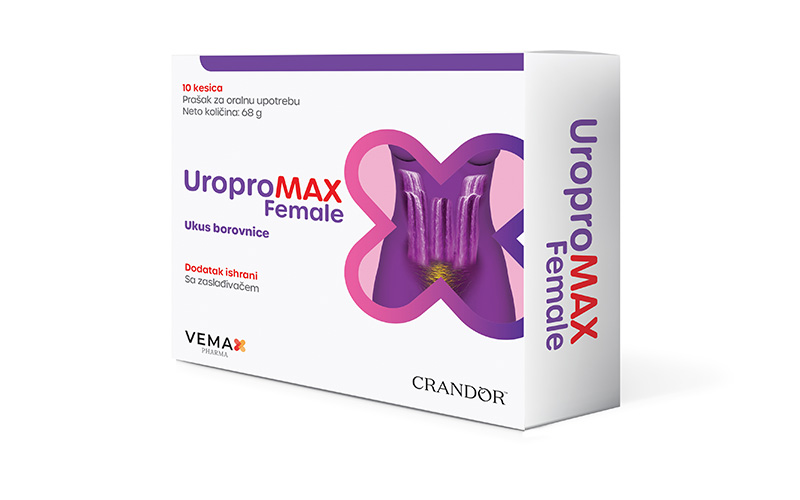
UroproMAX Female® is a dietary supplement in powder form, specifically developed for women with acute and chronic urological conditions, as well as for maintaining vaginal and urinary microbiota. The product is formulated to act on four key levels:
- Elimination of pathogens (mechanical elimination and biofilm disruption)
- Regeneration and protection of the urothelium and vaginal mucosa
- Maintenance and regeneration of the microbiota
- Prevention of relapse and functional support
Composition:
- D-mannose
- N-acetyl cysteine
- Chondroitin sulfate
- Patented standardized cranberry extract (Crandor®)
- Probiotics: Lactobacillus plantarum, Lactobacillus reuteri, and Lactobacillus rhamnosus – strains proven to be associated with vaginal and urinary health.
Used in cases of:
- Acute and chronic urinary tract infections (UTIs)
- Interstitial cystitis and bladder pain syndrome
- Vaginal dysbiosis associated with urinary infections
- Recovery after antibiotic therapy
- Prevention of urinary tract infections
- Support of microbiota and urogenital health during perimenopause and menopause
Directions for use:
- For prophylaxis and in cases of acute infections (as an adjunct to antibiotic therapy), take for at least 10 days, with a minimum interval of 2 hours between this product and antibiotic intake.
- In cases of recurrent/chronic infections, catheter use, and chronic bladder conditions, take for 6-12 weeks to achieve the expected results.
Recommendation: Take the product before bedtime, on an empty bladder.
Pour the contents of one sachet into a glass, then gradually add 200 ml of water while stirring until the powder is completely dissolved. Consume immediately after preparation.
Warning:
Do not exceed the recommended daily dose.
In case of any adverse effects, discontinue use and consult a physician.
Excessive use may cause a laxative effect.
Packaging:
10 sachets, powder for oral use, blueberry flavor
Mechanism of action:
D-mannose - Mechanical elimination of bacteria
D-mannose is a simple sugar that is readily absorbed in the upper part of the gastrointestinal tract and quickly excreted in urine. This natural monosaccharide is found in fruits such as blueberries and cranberries. It does not affect blood glucose levels and is rapidly eliminated via the kidneys.
Mechanism:
By binding to type 1 bacterial fimbriae (particularly E. coli – the main cause of urinary tract infections, responsible for up to 90% of cases) that are sensitive to mannose, it prevents their adhesion to bladder cells. The bacteria are then naturally eliminated through urine.
Result:
Instead of remaining in the urinary tract, the bacteria are naturally eliminated through urination.
Acetyl cysteine (NAC) – Bacterial biofilm disruption
A cysteine amino acid derivative with strong antioxidant and mucolytic properties. It breaks down bacterial biofilm, which protects pathogens from the immune system and antibiotics. Biofilm is a key mechanism in chronic and resistant infections – by removing this protective layer, bacteria become more vulnerable to the immune response and antibiotics.
- Increases drug penetration and reduces inflammation and oxidative stress
- NAC is one of the few ingredients with synergistic effects in anti-infective therapy – it enhances the effect of antibiotics and supports mucosal recovery
Chondroitin sulfate – Regeneration of the urothelial barrier
The bladder mucosa contains a glycosaminoglycan (GAG) layer that acts as a natural barrier against bacteria and urinary irritants. Chondroitin sulfate is a key structural component of this GAG layer. In the case of infections, this layer is degraded, allowing bacteria to penetrate tissues more easily and leading to symptoms such as pain, burning, and frequent urination.
Mechanism:
It restores the damaged mucosa, thereby reducing pain, irritation, and frequent urination. It is beneficial in interstitial cystitis.
Crand’Or™ TotalPAC patented standardized cranberry extract with a defined content of type A proanthocyanidins (PAC-A) – anti-adhesive and protective action
Standardized cranberry extract (Vaccinium macrocarpon), developed to contain a high concentration of bioactive compounds – especially type A proanthocyanidins (PAC-A), which are key to the anti-adhesive effect against bacteria.
Each dose contains a precisely defined amount of PAC-A, unlike standard cranberry preparations that often have an unregulated concentration and therefore a weaker effect.
PAC-A has a specific structural form that enables the inhibition of bacterial fimbriae (adhesive structures) of E. coli, preventing their attachment to the urothelium.
Mechanism:
- PAC-A blocks P fimbriae and type 1 fimbriae in E. coli, which the bacteria use to adhere to bladder cells.
- In this way, bacteria cannot establish permanent attachment and are more easily eliminated through urination.
- The effect is particularly important after sexual intercourse, as this is when bacteria have the greatest chance of colonizing the urethra and urinary tract.
- It also has antibiofilm properties – it prevents the initial stage of biofilm formation.
Probiotics (L. plantarum, L. reuteri, L. rhamnosus) – Vaginal and urinary microbiota
Mechanism of action:
- Reduce adhesion of pathogens (E. coli, Gardnerella, Candida),
- Produce lactic acid → maintain an acidic pH,
- Block biofilm formation,
- Activate local immune response and stimulate the production of antimicrobial peptides.
Lactobacillus plantarum LB931 (1 billion colony-forming units) – Microbiome restoration
L. plantarum is a robust, facultative anaerobic strain that naturally inhabits the intestines, but also shows the ability to temporarily colonize the urogenital tract.
Mechanism of action:
- Pathogen inhibition: produces organic acids (lactic acid), lowers pH, and prevents the growth of E. coli and other uropathogens. It is also a strong inhibitor of Candida and Group B Streptococcus.
- Production of antimicrobial substances: produces bacteriocins and H₂O₂ that directly inhibit uropathogens.
- Biofilm control: reduces biofilm formation, which helps in recurrent infections.
- Immunomodulation: Stimulates the production of anti-inflammatory cytokines (IL-10) and reduces TNF-α and IL-6, which is important in chronic cystitis.
Lactobacillus rhamnosus CRL1505 (10 billion colony-forming units) – Microbiome restoration
One of the best-known vaginal probiotics, widely used in the treatment and prevention of bacterial vaginosis and recurrent UTIs.
Mechanism of action:
- Adhesion to the vaginal epithelium: occupies binding sites that would otherwise be used by pathogens.
- Production of lactic acid: maintains a pH between 3.5 and 4.5 – an environment unfavorable for E. coli and Gardnerella vaginalis.
- Immune effect: stimulates local IgA production and increases mucosal resistance to infections.
- Synergy with antibiotics: reduces the risk of secondary infections following antibiotic therapy.
Lactobacillus reuteri LR92 (1 billion colony-forming units) – Microbiome restoration
A strain known for producing reuterin, a unique antimicrobial compound with broad-spectrum activity.
Mechanism of action:
- Reuterin production: inhibits the growth of E. coli, Klebsiella, and Candida spp.
- Anti-adhesive effect: reduces the binding of uropathogens to the vaginal and urothelial surfaces.
- Microbiota restoration: particularly important after prolonged antibiotic therapy.
- Immune support: modulates the inflammatory response and reduces oxidative stress in the vaginal mucosa.
Composition:
Active ingredients |
1 sachet |
D-mannose |
2,000 mg |
Cran d’Or™ TotalPAC – patented formulation |
500 mg |
N - acetyl cysteine |
300 mg |
Sodium chondroitin sulfate |
250 mg |
Lyophilized cultures of beneficial bacteria:
|
12 x 10⁹ CFU** |
**CFU - colony-forming units
Write to us
Mosorska 9, 11000 Belgrade, Serbia
Vemax011 Pharma doo representative office Northern Macedonia - Dane Krapcev 13, Skopje
Vemax011 Pharma doo representative office Montenegro - Topliški put 1, Budva
Vemax011 Pharma doo representative office Bosnia and Hercegovina - Vlakovo 252, Sarajevo
+381 (0)63 103 00 08
office@vemaxpharma.rs
Vemax Pharma - your trusted regional partner on the road to health!